
Do we need to rethink our wheat obsession?
Wheat is cultural, emotional and often the centrepiece of our diet. It's also just another crop, and far from the 'essential' food it's made out to be.
2/13/20261 min read

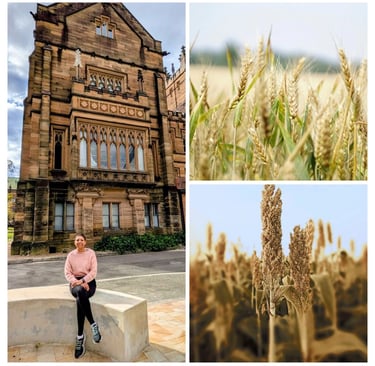
On a long Malaysian Airlines flight, my vegan meal turned out to be all refined flour: crackers, bread, a croissant. When I asked for something gluten free, the crew member smiled tightly and said, "Do you have celiac disease"
You can brush off those reactions, but what I struggle to ignore is seeing articles on LinkedIn and other platforms pushing wheat on a population level and repeating the same narrative I heard from the crew member.
I do not have celiac disease, and I grew up eating wheat. But like many others, I have gradually stepped back from it, not out of fear, but out of awareness.
Even Harari in Sapiens points out that it was not humans who domesticated wheat, it was wheat that domesticated us. Ten thousand years ago, our ancestors had diverse diets rich in fibre, variety, and micronutrients. Wheat changed that. It tied us to one crop, one system, and in the process, narrowed our nourishment. Harari even calls the Agricultural Revolution history's biggest fraud because it produced more food but not necessarily healthier humans. While this perspective is historical and philosophical, it illustrates how one crop shaped civilizations.
And Vandana Shiva takes that story further. She reminds us that modern agriculture, shaped by the Green Revolution, replaced ancient nutrient rich varieties with high yield crops dependent on chemicals and corporate control. What was once biodiversity that enriched the soil has now shifted into monoculture that depletes it.
Nutritionally, while ancient wheat varieties differ slightly in micronutrients and gluten composition, research shows that no single wheat variety is inherently "essential" to human health. Diets that emphasize diverse grains: millet, amaranth, buckwheat, quinoa, teff - provide comparable or greater minerals, fiber and protein, are gentler on digestion, and grow as resilient, environmentally sustainable crops.
I am not anti-wheat. I do enjoy ancient wheat occasionally. But given its limited availability, higher cost, and the scientific evidence for diversity, it cannot realistically replace the range of grains we already have.
The real question is: Why continue to insist that everyone include wheat when scientifically supported, more sustainable and nutritionally diverse alternatives are available?